
Short answer
No. UK teachers do not have to label AI-generated images or teaching resources because of the EU AI Act.
The EU AI Act’s transparency rules did start on 2 August 2026. They do not mean a UK teacher has to stamp “AI GENERATED” across a worksheet.
The marking duty in Article 50 sits mainly with the company that made the image, not the teacher who put it on a slide. The UK isn’t in the EU, so an ordinary English school isn’t automatically caught by it either.
What does apply to you is quieter and older: current DfE guidance tells school staff to acknowledge or reference their use of generative AI in their work, and to fact check what it produces. So a small footer is sensible. Not because Brussels says so. Because it’s honest, and because your students are watching how you handle it.
It’s Sunday afternoon and you’re making a sheet about brazing.
Not because you fancied a project. Because there’s a boy in your Year 10 who can hold about three steps in his head before the rest slide off, and last week he stood at the bench holding a rod, waiting, not asking. You’ve explained it twice. He needs to see it.
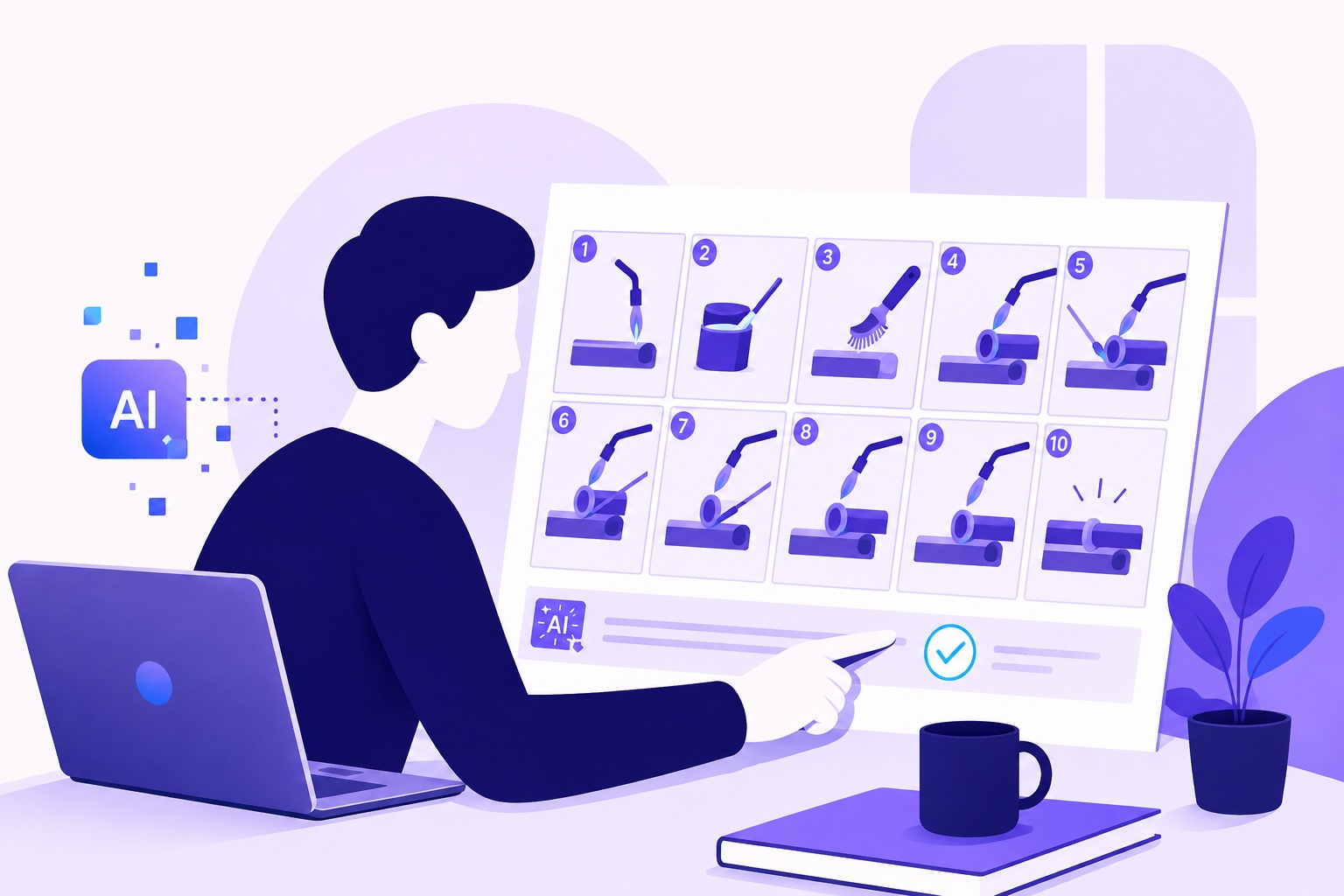
So you type a prompt, and ninety seconds later there’s a hand drawn looking sheet with ten numbered steps, a torch, a flux pot, a wire brush, the flame moving. The thing you’d have spent an hour hunting for on a resource site and still not found in the version you wanted.
Then on Monday somebody says it in the staffroom, in the voice people use for things they read on LinkedIn.
“You’ll have to label that now, you know. New law came in on the 2nd.”
And there it is. That small cold drop. The one where you’ve done something useful and now you’re not sure if you’ve done something wrong.
What actually changed on 2 August
The EU AI Act’s transparency rules, Article 50, started applying on 2 August 2026. That part is true and it’s why the claim is spreading.
Here’s what the Article actually splits into.
Providers of AI systems that generate synthetic image, audio, video or text have to make sure the outputs are “marked in a machine-readable format and detectable as artificially generated or manipulated.” Providers means the companies. OpenAI, Google, the people who built the model.
Deployers, which is the closer word for you, have a narrower duty. There are two situations that could conceivably touch a classroom resource. One is deepfakes, and the Act means something specific by that: image, audio or video made to resemble real people, places or events convincingly enough to pass as authentic. The other is AI-generated text published to inform the public on matters of public interest, and even then only where nobody has reviewed it and taken editorial responsibility for it. There’s a third deployer duty about emotion recognition and biometric systems, which won’t come near a worksheet.
An illustrated brazing sheet is neither of those. It isn’t a deepfake. It isn’t public interest journalism. And it has passed through human editorial control, because you looked at it, decided whether the flame was in the right place, and chose to put it in front of children.
The other thing worth saying plainly: the UK left the EU. The Act reaches providers putting systems on the EU market and deployers established in the EU, or where the output gets used there. A school in Stoke using an AI illustration in a Year 10 lesson isn’t in that net.
So the staffroom version of this is wrong. Not maliciously. It’s just what happens when a real date and a real law get compressed into one sentence and passed along.
The label already exists. You just can’t see it
Here’s the part almost nobody mentions, and it’s the bit I find most interesting.
Supported images generated in ChatGPT already carry provenance signals baked into the file: C2PA Content Credentials, and a SynthID watermark embedded in the image itself. That’s the kind of machine-readable marking Article 50 asks providers for, although no EU authority has certified any particular technique as meeting the standard. Coverage varies by model, export path and file type, so it isn’t guaranteed on every image.
It’s also fragile. Screenshot it, paste it into PowerPoint, upload it somewhere that strips metadata, and the credential can vanish. Which tells you something useful. The provider side of this is being built out, it’s imperfect, and none of it was ever designed to be the thing a Year 10 sees.
So the footer you’re wondering about was never a legal requirement. It’s a professional one. Different question, better question.
The guidance that does apply to you
The DfE’s guidance on generative AI and data protection in schools was updated on 9 July 2026. Under compliance, it lists things staff should do, including:
“acknowledge or reference the use of generative AI (artificial intelligence) in your work”
and
“fact-check results to make sure the information is accurate”
I want to be careful here, because I’ve seen this quoted as if it’s a labelling mandate for classroom resources and it isn’t quite. It sits in a data protection section and it’s written to staff about their own work, in the same breath as checking your tool is approved and knowing what happens to personal data. It’s a professional conduct expectation, not a badge rule.
But it points the same way. And the DfE’s wider AI guidance is blunter about where responsibility lands:
“The quality and content of any final documents remains the responsibility of the professional who produced it and the organisation they belong to, regardless of the tools or resources used.”
That sentence is the whole thing, really. Nobody is coming to check your worksheet footer. Somebody absolutely will ask, if a diagram is wrong and a child follows it, who checked it.
The footer worth using
Small. Bottom corner. Same place you’d put a source line.
AI-generated visual, teacher checked
That’s it.
The first half is honest about where the image came from. The second half is the part that matters more, because it says a professional looked at this and took responsibility for what pupils were shown. It’s the difference between a disclaimer and a signature.
Compare it to the alternatives.
“Illustration created with AI” is fine but it’s only half the sentence. It tells students where it came from and says nothing about whether anyone checked.
A big warning triangle across the top of every sheet is worse than nothing. Do that for eight weeks and it becomes wallpaper. Students stop reading it, and you’ve spent your credibility on a symbol that no longer means anything. Over-labelling is how transparency turns into noise.
The bit that made me want to write this
Here’s where it stops being about compliance.
JCQ’s guidance on AI use in assessments is clear that where students use AI as a source, they have to acknowledge it. The reference must name the AI tool used, and should show the date the content was generated. That’s the standard we hold them to. In my subject that lands in portfolio work, in annotation, in the stuff we’re constantly telling them to evidence properly.
Now think about how it looks if every resource we hand them arrived from nowhere. Polished, illustrated, unattributed, apparently just materialising.
We’d be asking students to show their sources while quietly hiding ours.
A tiny footer on a worksheet fixes that without a single conversation. Repeated across a term, it teaches something we’re otherwise struggling to teach: that AI generated things exist, that they’re useful, that they get checked by someone who knows the subject, and that saying where something came from is normal rather than an admission.
That’s provenance taught by habit instead of by assembly. I’ll take that.
And the reason you were doing this anyway
Let’s not lose the thread. You didn’t make that sheet because you wanted to play with a new tool.
You made it because a visual sequence is ordinarily available provision, and because “more visual support for task completion” is written on a fair few of your students’ plans, and because until recently that meant either finding something that half fitted or making it yourself at 9pm.
Ten numbered steps, one image each, in the order you actually teach them. That used to be an evening. Now it’s the length of a kettle boiling.
The workload question and the ethics question aren’t in tension here. Check it properly, say where it came from, move on with your evening.
Do this now, in five minutes
- Make the footer once. Put “AI-generated visual, teacher checked” in a text box in your department slide template and your worksheet template. Done for every future resource.
- Check one image properly. Take the last AI visual you made and look at it as a subject specialist, not a proud maker. Is anything in the wrong order? Is any tool doing something it can’t do? Fix or bin it.
- Say one sentence to your class. “I made this with AI and I’ve checked it. If you spot something wrong, tell me.” Thirty seconds. It does more for AI literacy than a whole assembly.
If you lead a department, there’s a fourth.
Put one line in your handbook so nobody has to guess: AI-generated visuals are fine in our resources. Check them for subject accuracy, and footer them “AI-generated visual, teacher checked”. Sixteen words and your team stops asking permission one at a time.