
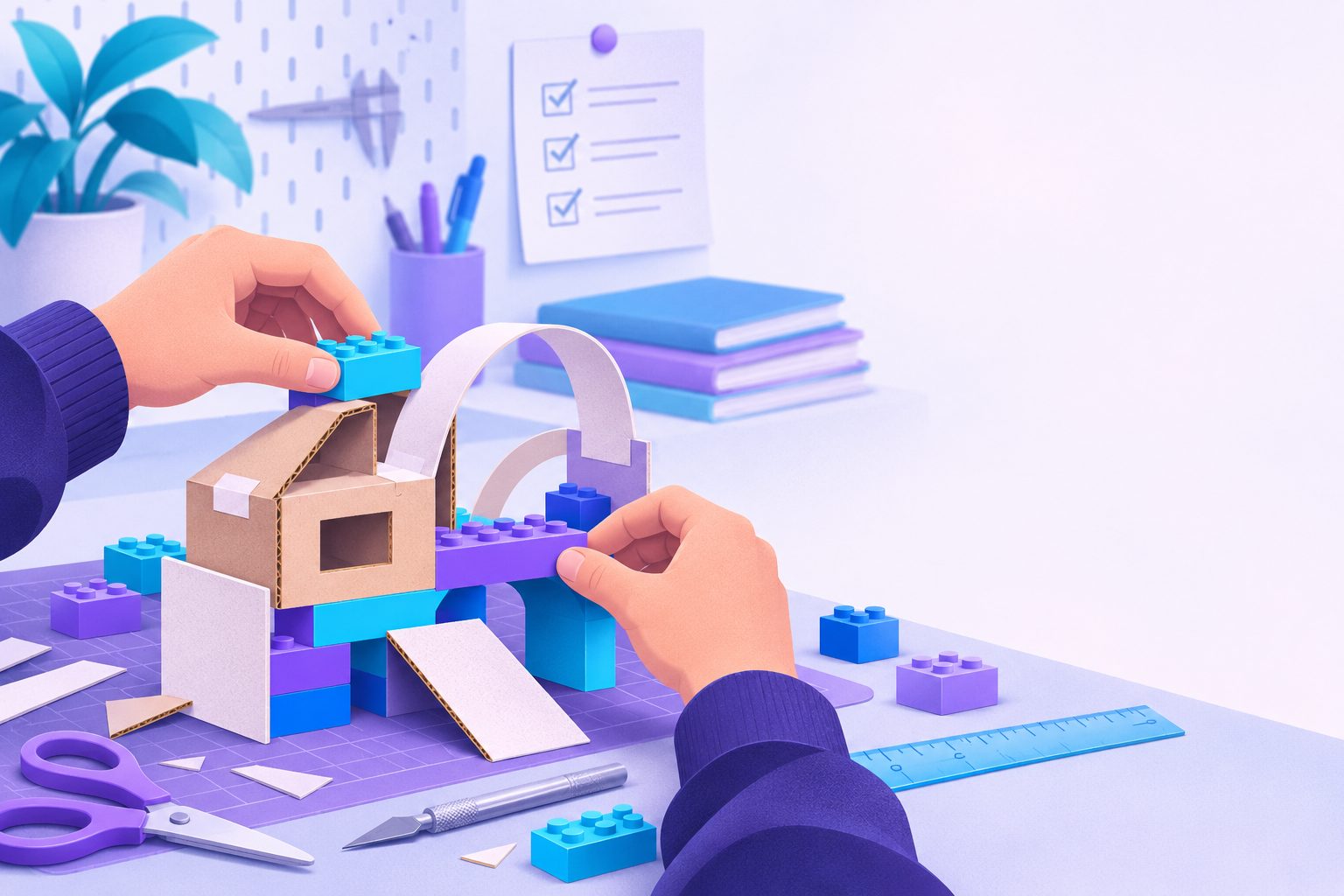
Learning through play in secondary schools rarely survives the pressure of assessment, procedure and data. I think that’s costing our pupils more than we realise, and I think design and technology shows us a way back to playful learning.
Early this morning I read Christopher Raeburn’s reflections on this year’s Annual Conran Lecture at the Design Museum. LEGO’s design leadership team spent an hour talking about creativity, curiosity, constraints and play. While they talked, each of them built a brand new LEGO set on stage.
Not all four sets got finished. Raeburn saw that as a fitting picture of everything they were describing, and that sparked something in me.
Picture it for a second. Senior designers at one of the most successful companies in the world, discussing serious ideas about innovation, with their hands busy and bricks scattered across the table. Nobody needed the build to be complete to prove the thinking was happening. The making was the thinking.
For LEGO, play and design go hand in hand. Design isn’t a department bolted onto the side of the business. It’s how the whole organisation thinks, learns and creates.
It left me questioning my role as an educator. If a company that’s nearly 100 years old can keep play at the heart of everything, and still innovate, still grow and still be one of the most loved brands on the planet, what are we doing in schools?
Have we made learning too serious?
I’ll put my hand up first. I teach GCSE 3D Design and lead a D&T department, and a lot of my thinking time goes on evidence. Is the AO1 research there? Is the annotation deep enough for AO3? Will the moderator see what I can see?
I understand why. When the whole system is sequenced backwards from a terminal exam or a portfolio mark, every lesson starts to lean towards what can be recalled, retrieved and proven. Retrieval practice matters and I’d never argue otherwise. But somewhere along the way, the proving started to crowd out the learning.
I’m not against constraints. Every real design brief has them: a user, a budget, a material, a deadline. LEGO’s designers work within a system of around 12,000 different elements, and they talked about how those limits fuel creativity rather than block it. Constraints are part of design.
What I struggle with is the interruption. A student gets an idea, the momentum builds, and then we stop them to make sure the assessment criteria are visibly evidenced. Nobody thinks like that naturally. Real designers loop back, abandon things, sketch on the back of a receipt and return to it three days later. We ask teenagers to do it in a neat, assessable line, and then wonder why the spark goes quiet.
Every subject has its own version of this. The hypothesis written up before anyone’s touched the equipment. The essay plan shaped to the mark scheme before the idea has had a chance to form.
What pupil wellbeing data tells us about school
The wider picture makes this much harder to ignore.
NHS England’s most recent survey found that one in five children aged 8 to 16 had a probable mental disorder in 2023, up from one in six the year before. It’s still the latest official picture we have. Support hasn’t kept pace. When those figures came out, England was the only UK nation without a government-funded school counselling service.
When children are asked directly, school keeps coming up. The Children’s Society’s Good Childhood Report has found, year after year, that school is the part of life young people are least happy with. Their happiness with school and schoolwork has fallen steeply since 2009/10. In 2025, getting good grades became young people’s top worry about the future, named by 43% of them.
Then there’s the move to secondary. A study of more than 100,000 pupils across England in 2024/25 found that over one in four begin to disengage during Year 7. Their enjoyment, trust, sense of agency and feeling of safety all drop sharply during Year 7, and for most they never fully recover. The gap is wider still for pupils eligible for free school meals.
Read those together and a pattern shows up. Children arrive at secondary school mostly enjoying it. Within a term or two, many don’t. And the thing they’re most worried about is their grades.
Enjoying school and enjoying learning aren’t the same thing
Ask a room of teenagers whether they enjoy school and you can probably guess the answer. Ask whether they enjoy learning and it gets more interesting. Are they curious? Do they make up stories, take things apart, invent games with rules nobody else understands? Undeniably, yes. Watch any Year 7 in their first week of September.
So the curiosity hasn’t gone anywhere. What’s changed is the container we’ve put it in.
That isn’t just a hunch. A Chartered College research review on play and creativity in secondary schools notes that learning through play can support engagement, inclusion and social and emotional learning well beyond the early years. Yet most pupils past early childhood rarely get the chance to learn playfully at school.
Secondary has a habit of treating play as something you grow out of, a primary thing, and I’ve written before about why I’m fighting for play for students and teachers. Reading about LEGO reminded me that some of the most serious thinkers in design never grew out of it at all.
I want to be fair to that container, because I work in it and I believe in the people who do. Schools carry an enormous weight now. We’re protecting young people from things happening well beyond the school gates. We’re trying to be the stable place in lives that aren’t always stable. Most of us came into this because we believe in equity, and in giving every child the cultural capital others pick up at home. That’s real, and it matters.
But every new responsibility arrives with a procedure, and every procedure takes up a little more room. Policies, logs, sign-offs, consistency checks. None of them are bad on their own. Together, they leave very little space for something as hard to measure as play.
Raeburn wrote about LEGO’s idea of a product as the starting point for somebody else’s story, rather than a finished thing. He reflected that the value of design lies partly in “what the person using it is inspired to do next.” Reading that, I thought: that’s childhood in a nutshell. And if I’m honest, I worry that school as a product often does the opposite. We hand over the finished proposition, then mark how accurately it was received.
Why design and technology keeps learning through play alive
This is where I start to feel hopeful. The way LEGO’s designers described their work, curiosity within constraints, making to think, iterating on something familiar until it becomes new, is a pretty good description of a D&T lesson on a good day.
D&T is one of the few places left in the secondary timetable where learning through play still has a purpose. Students handle materials before they fully understand them. Prototypes fail and that’s useful. They test ideas on real people, change their minds and try again. Productive failure isn’t a bolt-on here. It’s how the subject works.
That hasn’t protected us, mind you. GCSE D&T entries have fallen by roughly two thirds since 2010, squeezed by accountability measures that rewarded other subjects. I’ve watched colleagues fight for curriculum time, workshop budgets and technician hours.
But there are small signs the system is starting to listen. The Curriculum and Assessment Review, published in November 2025, recommended cutting GCSE exam time by at least 10% and scrapping the EBacc measure. D&T specialists who advised the panel welcomed its recognition of D&T as a vital subject. A new national curriculum is due from 2028. None of that is radical on its own, but it’s movement in the right direction.
In the meantime, there’s something we can do in our own rooms. On your next unit, protect one lesson for pure exploration. In D&T that might be materials and a loose brief. In English, writing nobody will mark. In science, time with the kit before the method sheet comes out. No success criteria, no evidence to capture, just permission to play. Then, the following lesson, ask students to look back and tell the story of their thinking. The evidence still gets captured. It just comes after the creativity rather than cutting through it.
That’s what the LEGO team did on stage, really. They built first and talked about it as they went. Nobody marked them down for the sets they didn’t finish.
Is there still room for learning through play in secondary schools?
I’d love to see education do something genuinely radical. The thought that we might is honestly what keeps me in it.
I don’t know if the system will ever put learning through play in secondary schools at the centre of how we teach. But I do know that every week, in workshops and art rooms up and down the country, young people are picking up materials and making something nobody asked them to make. That curiosity is still there. Our job might simply be to stop getting in its way.